Should I Be Allowed To Kill My Aunt?

My aunt is not going to die of Alzheimer’s disease, though she is certainly going to die with it.

Generally, Alzheimer’s does not kill its victims, it merely acts as an enabler.  Having eaten away at memory, then reasoning and language, it eventually works its way into the brain stem which controls the nervous system and the functions that we perform unconsciously, such as breathing.  Frequently, Alzheimer’s sufferers lose control of the swallowing reflex and breathe food and drink into their lungs.  This can lead to death from aspiration pneumonia.

Having gone through the stage where she tried to eat the pattern off the plate, my aunt can now no longer feed herself, not that she has much of an appetite.  She needs to be spoon fed, and can scarcely hold her “sippy cup”, let alone direct it to her mouth to drink.  She still has the power of speech, although that power is severely limited.  As the disease took hold, her conversation turned into the sort of predictive text you get on a phone; each word is one that might frequently follow the previous word, but the short-term memory loss meant that the purpose of the sentence was lost, and all that was left was a string of words, each related to the previous word, but without a subject.  Since then, her speech has deteriorated further.

Some time ago, maybe a couple of years, when she could still, occasionally, string a short, coherent sentence together, she expressed the desire to die.  That wish has yet to be granted.  At the time of writing, there is a bill on assisted dying under consideration by the British parliament.  That bill would grant terminally ill people with a prognosis of less than six months to live, the right to die before that time, if they so choose.  I doubt that my aunt will last that long – she is bed-bound and wasting away – however, assuming that the bill had been enacted, she would not be granted her wish to die.  That’s because she could no longer express that wish.  One of the safeguards in the bill is that this should be a decision for the individual, not for anyone else: the bill would not allow me to sign my aunt’s death warrant.  Furthermore, the individual making that decision must have capacity: the ability to make their own decisions.  Almost by definition, someone with a degenerative brain disease like Alzheimer’s will lose capacity.  That’s what it does.  It eats away at executive functions – the ability to recall from memory at will, the ability to remember decisions made, the ability to make decisions, the ability to act on decisions and the ability to express them.  At the time when she expressed the desire to die, she would not have been able to consult two independent doctors and bring her request before a court; even if she remembered the wish, she would need someone (someone like me) to help her through the process, and bringing my aunt through the official stages of the process would look an awful lot like coercion.

The provisions of the current bill specifically exclude people with mental illness.  There is a potential way to include them – at least, to include degenerative conditions such as dementia.  I would like to see a “living will” approach adopted: somebody with mental capacity should be able to specify whether or not they would opt for assisted death if they reach a condition in which they are in a terminal decline and no longer have mental capacity.  This minimises the opportunity for coercion, since the decision can be made long before the evidence of the disease, let alone the debilitation.

So should I be allowed to kill my aunt?  Currently, I am not.  Under the bill going through parliament, it would be forbidden.   Even under my suggested extension, I would not be allowed to sign my aunt’s death warrant; when she had all her faculties, she was unwilling to contemplate her own death, so she would not have made a living will setting out the conditions under which her life should be terminated.

My aunt was came from a family of four siblings.  The eldest, my mother, died with Alzheimer’s disease.  The other three all now have the disease.  A complete generation of a family developing dementia suggests a genetic susceptibility to the disease.  My father and his siblings all lived to a similar age to my mother.  None of them developed dementia.  I don’t know if I have inherited the genetic marker for the vulnerability from my mother, but I have a 50% chance of doing so.  With that 50% comes the likelihood of losing executive function – the will to do anything and the ability to carry it out; the very things that make me a part of human society.  I do not want this legislative change for my aunt.  I want it for me.

Mortgage vs Rental

This is a thought experiment.  It concerns two couples: the Austins and the Browns.  As far as we are concerned, they have identical qualifications, identical jobs and identical tastes.  So similar are these two pairs that they got married on the same day.  On the Austins’ wedding day, the proud parents clubbed together and presented the happy couple with the deposit on a house.  On the Browns’ wedding day, their proud parents clubbed together and presented the happy couple with a toaster.

On the strength of their earnings, backed by a healthy deposit, the Austins were able to get a 25 year mortgage on a house.  On the strength of their earnings, but without a deposit, the Browns were not able to obtain a house, so they rented.  By the sort of coincidence that is the essence of thought experiments, the Browns’ initial monthly rental payments were identical to the Austins’ mortgage repayments.  The Browns’ house was not as desirable as the Austins’ (because the Browns were paying the landlord’s mortgage, other business costs and a small profit), but in other respects was very similar.  Thereafter, they made the same life choices (which we can therefore safely ignore).

So what happened to the Austins and the Browns?

To understand their finances, we can ignore general inflation, but we need to remember that (on average), British house prices have risen at a significantly faster rate than general inflation.  Over the past 70 years, Halifax bank calculates that house prices have risen by 300% in real terms (source) which means an average of 1.6% above inflation per year.  Over the life of a 25 year mortgage, house prices rose by 48%.

The Austins paid their mortgage for 25 years.  Of course, during that time, they were also paying interest, but they made the same monthly payment for the whole term of the mortgage, and cleared the debt after 25 years.  Assuming that they were paying 5% of the loan per year (to cover interest and reducing the principal), over the 25 years, they paid 122% of the original value of the house, but in the end, they owned outright a house worth 148% of the original value.

The Browns started off paying the same monthly amount as the Austins.  However, rents are a function of current house prices, not original purchase price, so every year the Browns’ landlord put their rent up by 1.6% above inflation.  So, at the end of the 25 years, the Browns had paid 12% more than the Austins and were still living in a rented house.  Furthermore, whilst the Austins’ mortgage costs dropped to zero after 25 years, the Browns had to carry on paying rent.

So what do we learn from this thought experiment? 

  1. There is a comforting idea – comforting to those of us who have bought our own houses – that the value of our property is the result of our hard work.  Poppycock!  House price inflation takes no work whatsoever.
  2. The value of our property depends to the greatest extent on our ability to get onto the housing ladder early, and that depends of having money for a deposit.
  3. In the long term, renting costs more than buying a house, yet the people who cannot afford to buy have to rent.
  4. As a result of paying less in the long term (and paying nothing after paying off a mortgage), home owners will tend to have accumulated wealth which might be used to give to the next generation for house purchase or to become landlords.  Housing capital is accumulative and tends to concentrate wealth.

Does this matter?

Housing security is fundamental to the well-being of individuals and families yet currently we have chosen to make the well-off secure and to give the well-off a simple method of increasing their wealth whilst those without capital are charged more and excluded from house purchase.  This seems fundamentally unfair, as does the systematic concentration of wealth in fewer hands through capital accumulated with no effort.  If we really wanted to level-up, if we really wanted Britain to be a property-owning democracy, we would do something about the housing market.

So what is to be done?

Well, personally, I’m going to come back to potential solutions in further blog posts.

Quasi Economical

On 23 September 2022, Kwasi Kwarteng staged something he called a “fiscal event”.  That wording seems to have been chosen to avoid the political/economic scrutiny that would be due to a budget.  Instead his measures were scrutinised by the financial markets, which reacted with a huge sell-off.

I’m going to ignore the aftermath and look at what Kwarteng and PM Liz Truss were trying to do.  The fiscal event was a reduction in taxes, notably income tax.  Reductions in income tax naturally benefit people who earn income, and higher earners gain most from tax reductions.  This was underlined by Kwarteng’s abolition of the highest (45%) tax rate, previously levied on annual incomes of over £150 000.  Truss and Kwarteng repeatedly described this as a plan for growth.  And that is my concern here: does making rich people richer lead to growth?

Growth is a measure of total economic activity; an increase in the production of goods and services.  The Kwarteng-Truss economic theory is that if rich people are taxed less, then they will use their increased wealth to invest in the creation of the sorts of goods and services that made them wealthy in the first place.  The theory suggests that this creation of additional goods and services benefits society as a whole because the total wealth of society has increased.  So there are two questions to be addressed: firstly, does dividing the pie (Truss’s phrase) in such a way that wealthier people keep a bigger share actually cause growth in overall economic activity?  Secondly, does economic growth automatically benefit all sectors of society?

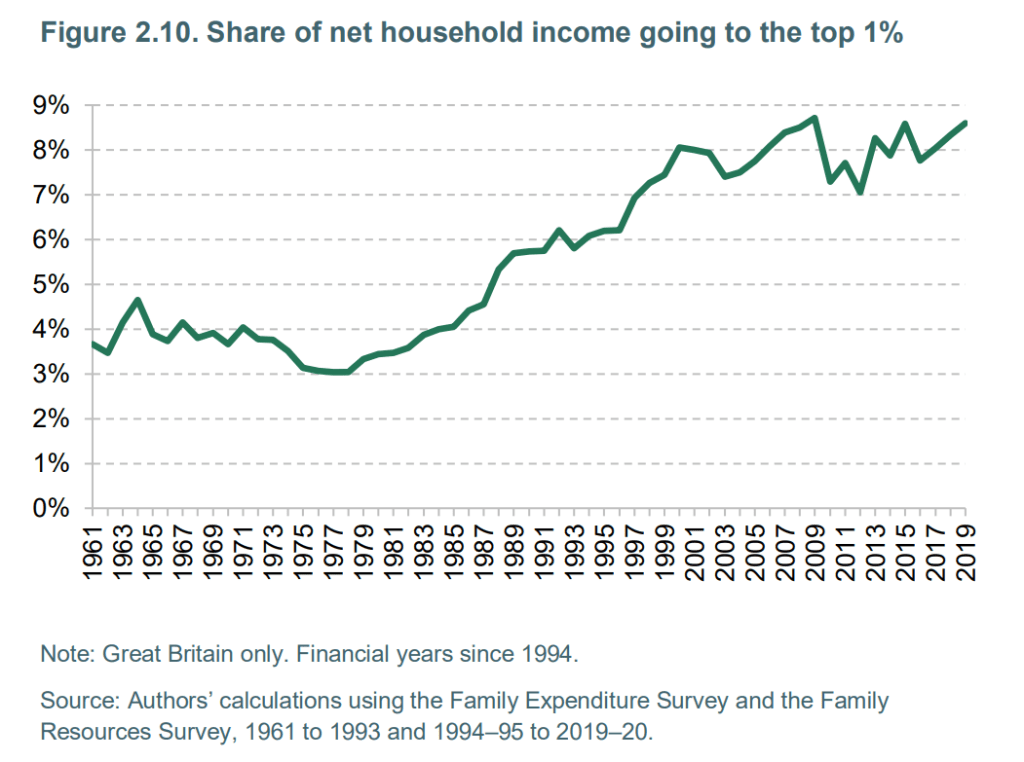
We should be able to answer the first question by looking at what has happened when the rich have increased their share of the pie.  Where might we find such a society?  Funnily enough, I found it in the House of Commons library in Brigid Francis-Devine’s 2021 report “Income inequality in the UK”.

What the graph tells us is that between the mid 1970s and the present day, the top 1% of UK earners have seen their share of national income rise from about 3% to over 8%.  So 1% of the earning population receives 8% of all available income.

So we already live in a society of the sort described by Truss, where wealthy people have progressively received more of society’s income.  According to Kwarteng and Truss, this is a good thing.  According to their theory, the more income that rich people get, the more the economy will grow.  So is that true?

Here we turn to the Office for National Statistics and their publication of changes in the economy since the 1970s :-

According to Trussonomics, having a greater share of income going to the top 1% should have caused the rate of growth to increase.  Instead, over the period where the top earner’s share of income has increased, growth has remained stubbornly flat (in fact a very small downward trend).

So we have demonstrated clearly that increasing the share of income going to the highest earners does not increase growth in the economy as a whole.  We’ve tried that experiment: it didn’t work.  If we return to the first graph for a moment, we can also see whether the average 2% growth of the past fifty years has benefited the whole of society.  The fact that the richest have grabbed an increasing share suggests that they have benefited disproportionately compared to society as a whole.

So does making rich people richer lead to growth?  No it does not.  The Kwarteng-Truss economic theory is, at best, a load of cobblers, and very likely damaging to the economy as a whole.